

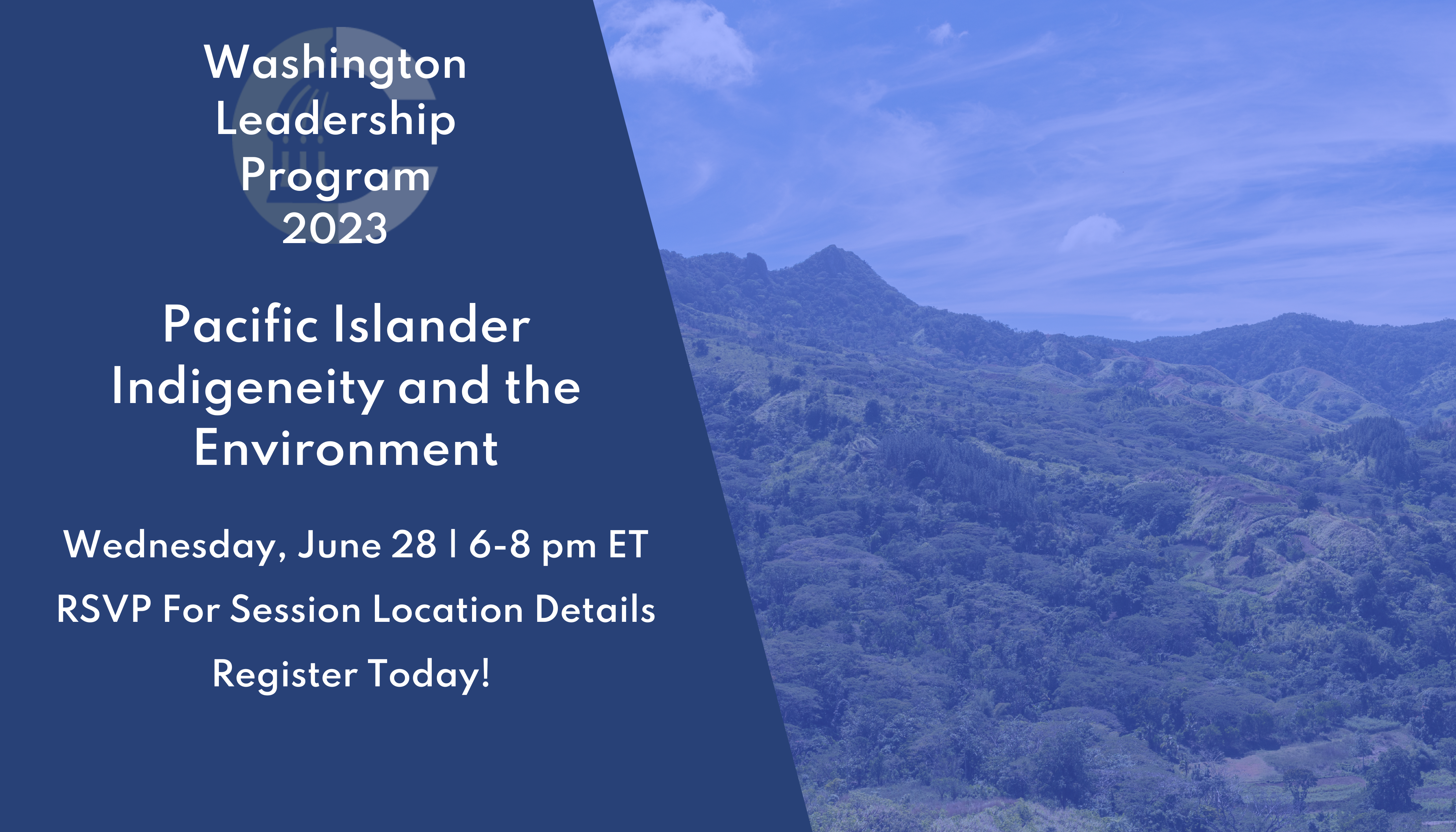
This session will focus on issues impacting the Native Hawaiian & Pacific Islander community-particularly around environmental developments, impact of tourism, and the intersection between identity and the environment.
Moderator
 Meeyoung Tawerilmal | Advocate, ASP
Meeyoung is an active Educator, Accredited Staging Professional and Entrepreneur expanding creativity in art and spaces from Federated States of Micronesia. She holds a Master of Arts Degree in Leadership and Management. Her advocacy work and vast leadership focuses on community organizations and Compact of Free Association issues.
Panelists
 Angelo Villagomez | Senior Fellow, Center for American Progress
Angelo Villagomez is a Chamorro conservationist and senior fellow at the Center for American Progress, where he focuses on Indigenous-led conservation. He was born in Guam, an island in the western Pacific Ocean next to the Mariana Trench, and holds bachelor’s degrees in biology and environmental policy. For the last 20 years he has advocated for the protection of marine monuments in the Pacific islands and global shark conservation. He is one of the architects for the movement to protect 30% of the ocean by 2030.
 Esther Wozniak | Manager, International Fisheries
Esther Wozniak is a manager with Pew’s international fisheries project, working to reform high seas longline fishing by improving transshipment regulation and monitoring longline fisheries. She focuses on advocacy efforts within countries, with regional fisheries management organizations, and with United Nations agencies to ensure the sustainability of global fisheries. Wozniak previously worked on Pew’s global shark conservation project, leading efforts in the Pacific region to manage and conserve sharks and rays. She also successfully pushed for protections to regulate international trade of sharks and rays at the Convention on International Trade in Endangered Species of Wild Fauna and Flora. In addition to her conservation work, Wozniak focuses on multiple efforts within Pew to advance inclusion, diversity, and equity.
Before joining Pew, Wozniak worked on the intersection between ocean science and policy at the University of the South Pacific, the Howard Hughes Medical Institute, and the International Union for Conservation of Nature, where she provided conservation research support for the IUCN Red List of Threatened Species.
Esther is part Fijian and holds a bachelor’s degree in marine science from the University of the South Pacific, Fiji.
 Laakea Stone | Legislative Correspondent/Appropriations Aide, Office of Senator Mazie Hirono
Laakea Stone, born in Honolulu, Hawaii and raised in Hilo, Hawaii is a queer Native Hawaiian and lifelong member of Halau o Kekuhi, the traditional dance company and center of cultural knowledge for the Edith Kanakaole Foundation. He moved to D.C. in the Summer of 2019 for an internship at the National Council of Asian and Pacific Americans (NCAPA) through the Council for Native Hawaiian Advancement (CNHA) immediately followed by a legislative fellowship in the Hawaii delegation through the Office of Hawaiian Affairs (OHA) and Kamehameha Schools (KS). Currently, Laakea is a Legislative Correspondent and Appropriations Aide for U.S. Senator Mazie K. Hirono. Laakea obtained a Bachelor of Arts in Linguistics and the Pre-Law certificate from the University of Hawaii at Hilo in 2018. He is an only child and is also allergic to peanuts.
 Lauren Swaddell | Senior Associate, Pew Charitable Trusts
Lauren Swaddell works across Pew’s environment portfolio to secure conservation outcomes that provide long-term benefits for both nature and people. She supports Pew’s engagement in international forums, marine protected areas, Pacific conservation, Indigenous engagement, and climate change.
Before joining Pew, Swaddell worked with the Guam Green Growth initiative to develop a plan on localized adaptations of the United Nations’ Sustainable Development Goals. She also was a Knauss fellow at the National Oceanic and Atmospheric Administration’s coral reef conservation program.
Swaddell holds a bachelor’s degree in environmental studies from Hunter College, City University of New York, and a master’s in environmental science from the University of Guam.
More About The Washington Leadership Program
The Washington Leadership Program (WLP) provides a space for young AANHPI students interning in Washington, D.C. to come together, build community, and explore their heritage within the context of public service. Through six sessions over the summer, WLP introduces students to AANHPI public service leaders who can inform and inspire students’ own civic engagement.
The Conference on Asian Pacific American Leadership (CAPAL) seeks to empower Asian American, Native Hawaiian, and Pacific Islander (AANHPI) youth by increasing access to public service opportunities and building a strong AANHPI public service pipeline. We envisions a future with equitable AANHPI representation throughout all levels of government and public service.
By registering for CAPAL’s Washington Leadership Program, you give permission to be recorded or photographed during the session. Food provided at this event may contain nuts, dairy, gluten, and other allergens. Vegetarian options will be available. We ask for all guests to follow our mask-required policy and masks will be provided to those without one. If you do not agree, we look forward to your virtual attendance.