

Washington Leadership Program
About
Through weekly sessions over the summer, the Washington Leadership Program introduces students to Asian American, Native Hawaiian, and Pacific Islander (AANHPI) leaders in public service who can inform and inspire students’ own civic engagement. Through panel discussions and participatory activities, this free program served over 1000 individuals in prior years.
Our 2026 Washington Leadership Program series is made possible through the generous support of the Mayor’s Office on Asian and Pacific Islander Affairs (MOAPIA).
This year’s theme is, “Chartering Homeland to Newfoundland: AANHPI’s Historic Timeline”. Through conversations with community advocates and public service leaders, attendees can learn about AANHPI histories and identities, as well as ways to become more involved in the public sector.
This event series is free and open to the public. In-person attendees will have the opportunity to meet other DC interns, ask panelists questions, and receive free dinner.
RSVP for CAPAL’s 2026 Washington Leadership Program here: https://forms.gle/i9kVqPR4cYrLLUrs7 to register and learn more about individual sessions below. RSVPs will be on a first come, first serve basis, up to the first 50 registrants per session. There will be a waitlist and standby line at every session at the in-person session venue.
Venue Info
CAPAL’s Washington Leadership Program Series will take place at multiple venue locations in Washington, DC. Please RSVP for updates on location.
Session Locations
June 10 | WLP 1: Bank of America, 1800 K St NW, Washington, DC 20006, USA
June 17 | WLP 2: APIAVote, 1025 Connecticut Ave NW # 600, Washington, DC 20036
June 24| WLP 3: APIAVote, 1025 Connecticut Ave NW # 600, Washington, DC 20036
July 1 | WLP 4: APIAVote, 1025 Connecticut Ave NW # 600, Washington, DC 20036
July 8| WLP 5: APIAVote, 1025 Connecticut Ave NW # 600, Washington, DC 20036
July 14 | WLP 6: Virtual
**Registration for virtual attendees will close at 3:00 pm ET on the day of the session. If you RSVP later, please tune into our Youtube channel here to watch our livestream**
Transportation/Parking
- Please RSVP to receive updates on transportation/parking.
Event Schedule
All WLP sessions are 6:00-8:00 p.m. ET with free dinner served starting at 5:30 p.m. ET. All sessions will consist of a panel discussion and audience Q&A, followed by optional networking and mingling afterwards with speakers and attendees.
- Registration & Dinner: 5:30-6:00 p.m. ET
- Panel Discussion and Q&A: 6:00-7:30 p.m. ET
- Networking & Mingling: 7:30-8:00 p.m. ET
CAPAL Event Media Waiver
Check the links below or sign up for our mailing list and follow us on X, Facebook, Linkedin, and Instagram for the latest updates on our 2026 WLP season!
2026 Washington Leadership Program Sessions
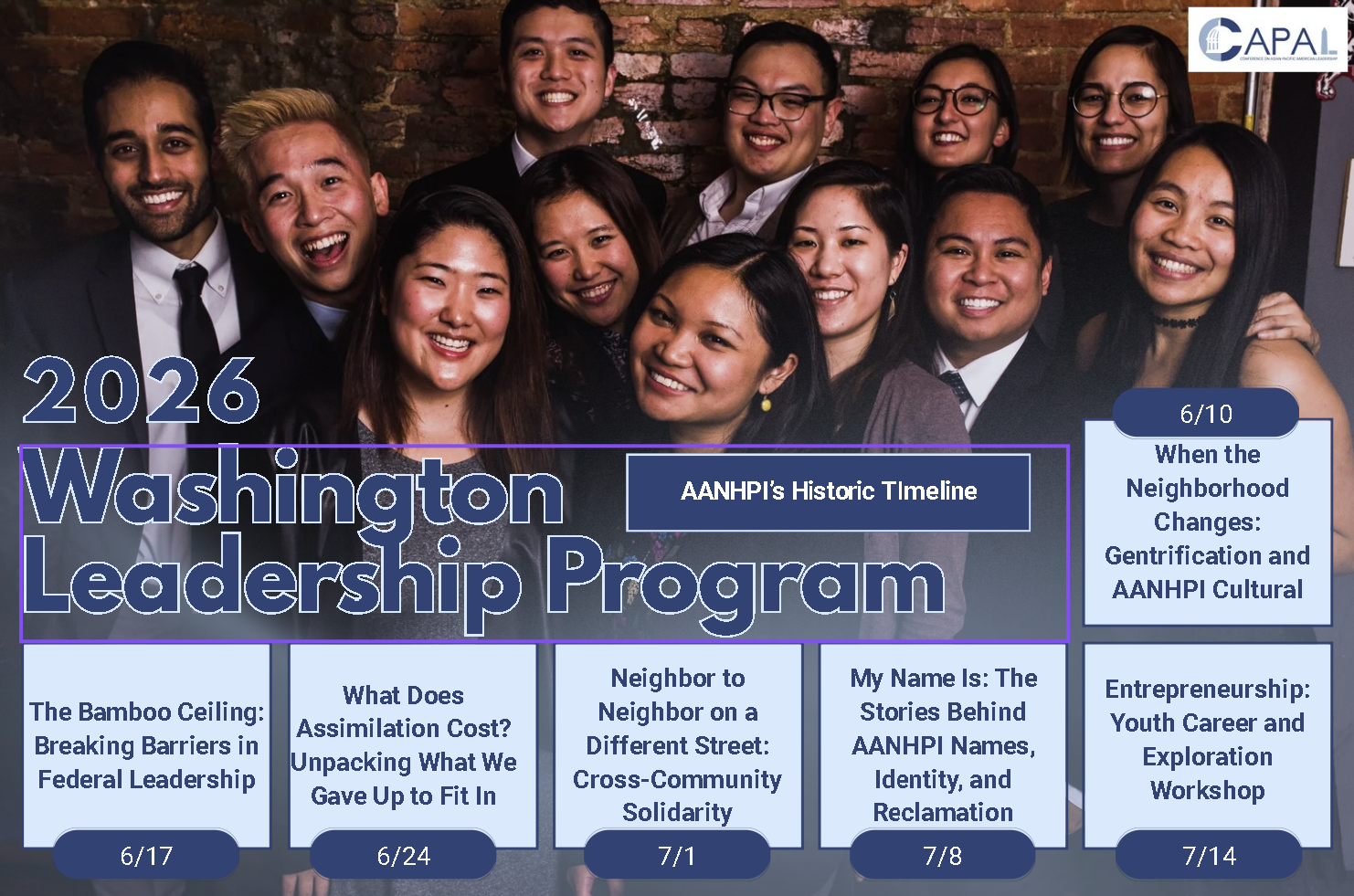
- June 10 | Session I | When the Neighborhood Changes: Gentrification and AANHPI Cultural Loss
- June 17| Session II | The Bamboo Ceiling: Breaking Barriers in Federal Leadership
- June 24 | Session III | What Does Assimilation Cost? Unpacking What We Gave Up to Fit In
- July 1 | Session IV | Neighbor to Neighbor on a Different Street: Cross-Community Solidarity
- July 8 | Session V | My Name Is: The Stories Behind AANHPI Names, Identity, and Reclamation
- July 14 | Session IV | (Virtual) Entrepreneurship: Youth Career and Exploration Workshop
Across the country, AANHPI neighborhoods are being transformed by rapid development, rising rents, and displacement — and with them, the restaurants, temples, community centers, and gathering spaces that have anchored our communities for generations. This session aims to address the question so many of us carry: what do we do when the neighborhood we grew up in no longer feels like ours? Through conversation with advocates, organizers, and community leaders, we’ll explore how AANHPI communities are responding to gentrification — and what it looks like to preserve, protect, and fight for our cultural presence in the places we call home.
Despite being one of the fastest-growing and most highly educated groups in the United States, AANHPI professionals remain dramatically underrepresented in senior leadership roles across federal agencies and public institutions, a phenomenon often described as the Bamboo Ceiling. Unlike the glass ceiling, which is at least visible, the Bamboo Ceiling is woven from cultural expectations, stereotypes about leadership style, and unspoken norms that can be nearly impossible to name and even harder to dismantle. This session brings together AANHPI leaders who have navigated these barriers firsthand, examining both the structural challenges that hold our community back and the strategies, networks, and mindsets that are helping break through them.
Assimilation is rarely a single dramatic choice; it happens in the small, accumulated moments: anglicizing a name, switching languages at the dinner table, leaving a traditional dish at home because you don’t want to explain it, laughing along when you don’t feel like laughing. For AANHPI communities, these moments carry real weight, shaping how we move through workplaces, schools, relationships, and our own sense of self. This session takes an honest look at what assimilation has cost us — culturally, personally, and collectively — and asks what it means to reclaim identity in a social and political climate that makes that harder than ever.
AANHPI communities have long existed alongside other communities of color, immigrant groups, and working-class neighbors, sharing blocks, schools, and cities, while navigating their own distinct histories of exclusion and belonging. Sometimes those relationships have produced tension and competition; sometimes they have produced some of the most powerful coalitions in American civic life. This session explores what genuine cross-community solidarity looks like in practice, as a lived commitment, featuring organizers and advocates who are actively doing the work of building bridges across difference.
A name is one of the first things we are given and one of the first things many in the AANHPI community are asked to give up: shortened at the border, respelled on a school roster, swapped for something easier to pronounce, or quietly set aside in the hope of fitting in a little more smoothly. But a name carries history, family, language, and love, and for many people the journey back to their own name is also a journey back to themselves. This session invites panelists and attendees alike to share the stories behind their names, the origins, the losses, and the quiet, powerful acts of reclamation that come with insisting your name be heard exactly as it is.
For many young AANHPI students, the path to a career, especially one that feels authentic to who you are, isn’t always clearly marked, and the entrepreneurial road even less so. This session brings together AANHPI entrepreneurs, innovators, and public service leaders to open honest conversations about career exploration, building something of your own, and finding your footing in industries where AANHPI voices have historically been underrepresented. More than résumés and job titles, this workshop is about possibility: helping young people see that their identity, heritage, and lived experience are not obstacles to overcome but foundations to build on. As the first fully virtual session of WLP 2026, it is designed to reach AANHPI students wherever they are in the country.
Learn More About Our WLP Series
Although we had a lively summer, we don’t have video recordings of our 2025 sessions. Here is a rundown of each session topic and our speakers:
Session I: Careers in Public Service
This session will invite speakers from various pathways within public service. Topics of discussion will center around what it means to be AANHPI in public service as well as the different avenues to become involved in public service (nonprofit, advocacy, local/state gov’t, etc)
Moderator: Kent Tong (he/him) is the Senior Programs Manager at OCA – Asian Pacific American Advocates, a 501(c)(3) national membership-driven nonprofit based in Washington, D.C. dedicated to advancing the sociopolitical and holistic well-being of all Asian Americans and Pacific Islanders.
Panelists
- Sirat Attapit is Vice President for Programs and Community Engagement at the Asian Pacific American Institute for Congressional Studies (APAICS). She comes to APAICS with over 25 years of experience in public policy, legislative affairs, government relations, and external affairs across both public and private sectors
- Cathy Yu recently served in the Biden-Harris Administration as the Chief Strategy Officer at the Export-Import Bank where she was responsible for optimizing the agency’s strategic direction. Previously, she served as a Deputy Assistant Secretary at the US Department of Labor where she managed a team to develop multifaceted strategies for rolling out the agency’s work to external stakeholders. Cathy also spent nine years in Congress in a variety of senior roles on various House and Senate committees,
- Dilpreet Sidhu is the Deputy Mayor of International Relations for the city of Los Angeles, where she leads a team that advances Los Angeles’ international relations, international trade and investment, and preparations for major global events, including the 2026 FIFA World Cup and 2028 Olympic and Paralympic Games. From 2021 to 2025 she served in the Biden-Harris administration in multiple roles. During the Obama-Biden administration, she served as Special Assistant to the National Security Advisor and held various positions at the Department of State
Session II: How Does DEIA Affect Me?
This session will revolve around the meaning of DEI initatives, as well as the impact on the AANHPI community and intersectional communities.
Moderator: Jackii Wang is a Senior Legislative Analyst for the Reproductive Rights and Health Team at the National Women’s Law Center. She previously worked at an anti-sexual violence organization advocating for reforms at the state and federal levels. Prior to that role, she served as a Legislative Assistant for Congresswoman Debbie Wasserman Schultz
Panelists:
- Zach Heng is a visionary HR leader, entrepreneur, and dedicated community advocate, committed to transforming organizations through executive coaching and fostering inclusive workplaces. With nearly two decades of experience, Zach has driven large-scale digital transformations and impactful people & culture strategies for global firms like Vanguard and Booz Allen Hamilton.
- Nicholas Lepham is the Operations Analyst in the Office of Supervision Policy and Operations (OSPO) at the Consumer Financial Protection Bureau (CFPB). In 2018, he co-founded ASPIRE, the employee resource group that focuses on the recruitment, retention, learning, and advancement of Asian Americans and Pacific Islanders at the CFPB.
- Zarana Shah Durham is a marketing leader with a passion for building thoughtful, data-driven customer experiences. As Director of Lifecycle Strategy at CleanChoice Energy, she focuses on connecting people to purpose through impactful engagement strategies. Zarana joined the board of CAPAL in October 2023, bringing with her a strategic mindset, global perspective, and a commitment to mission-driven work.
III: Public Policy & the AANHPI Community (Economics, Immigration, Healthcare & More)
This session will focus on various public policies such as: economics, immigration, and healthcare and their impact on the AANHPI community.
Moderator: June Kao is the Senior Audience Strategy Manager for Asian American and Pacific Islander (AAPI) and American Indian and Alaska Native (AIAN) audiences at AARP. June was also the Chair of AARP’s AAPI Employee Resource Group and previously worked as the Project Manager on Family Caregiving grant work at the AARP Public Policy Institute.
Panelists:
- Kelvin Lum (he/him) is the Director of Federal Policy for Stop AAPI Hate. A Capitol Hill veteran, he previously spent 12 years as a Congressional staffer for Rep. Ami Bera, M.D. (CA-06), the longest serving South Asian American Member of Congress. He most recently spent the last 6 years as Congressman Bera’s Legislative Director. For over a decade, Kelvin served as Rep. Bera’s liaison to the Congressional Asian Pacific American Caucus and Asian American & Native Hawaiian/Pacific Islander community stakeholders. He also spent seven years in the leadership of the Congressional Asian Pacific American Staff Association (CAPASA).
- Amanda Yuen serves as the Legislative Corespondent for Congresswoman Judy Chu (CA-28) where she manages the Member’s constituent mail program and covers a portfolio of issues including AANHPI affairs, civil/voting rights, nutrition and agriculture. She previously worked for U. S. Senator Laphonza Butler (D-CA) where she supported the education, labor, and banking teams.
- Rita K. Kuwahara, MD, MIH is a Primary Care Internal Medicine Physician and Senior Advisor for Medicine and Health Policy at the Association of Asian Pacific Community Health Organizations (AAPCHO). She previously served as Health Policy Advisor in the United States House of Representatives and Congressional Fellow in the United States Senate. She has held numerous national leadership positions and currently serves on Healio News’ National Primary Care Physician Peer Perspective Board.
- Dr. Sheri-Ann Daniels is the chief executive officer of Papa Ola Lōkahi, the Hawaiian health board, which supports the Native Hawaiian Health Scholarship Program, partners throughout Hawaii and the US and five Native Hawaiian Health Care Systems that provide direct primary, dental and mental health services, outreach, enrollment and health promotion across seven islands.
Session IV: Building Career to Burnout: Mental Health & Self-Care
Moderator: Angela Belisario is the Behavioral Health Coordinator for the Asian American Health Initiative (AAHI). She is responsible for developing behavioral and mental health programs to raise awareness and meet the needs of Montgomery County’s Asian American community.
Panelists:
- Krystle Canare (she/her) is a proud Filipina American. Director of NAAPIMHA, the National Asian American Pacific Islander Mental Health Association, a national organization dedicated to promoting and redefining the mental health of Asian American, Native Hawaiian, and Pacific Islanders (AANHPI) across the United States. Prior to NAAPIMHA, Krystle served as consultant for the Substance Abuse Mental Health Services Administration, an ambassador for the White House Initiative on Asian Americans & Pacific Islanders, health equity ambassador for the American Psychological Association.
- Wing Bui is a licensed clinical social worker and psychotherapist on Piscataway Land (MD & DC). Her work centers queer people of color and adult children of immigrants navigating grief and generational wounds.
- Dr. Christina Hong-Huber (she/her) is a licensed clinical psychologist based in Washington, D.C. where she runs her own private practice and also supervises and teaches doctoral level trainees. She works with undergraduate and graduate students as well as working professionals in fields such as medicine, law, politics, and consulting and works with majority clients of color.
Session V: From Boomers to Gen Z: Navigating Intergenerational Conversations
The final session will discuss how to navigate intergenerational conversations about topics such as political identity and how it relates to voter identity, voting patterns, etc.
Moderator: Catalina Calachan is a Business Technology Manager within the Community, State, and National Affairs group at AARP. In her role, she leads the implementation of enterprise-wide technology projects that advance the organization’s social mission. Outside of AARP, she also serves on the Arlington County (VA) Commission on Aging (COA). Through her work as the Chair of the Transportation Committee and a member of the Advisory Group for Arlington’s Transportation Future
Panelists:
- Victor Yang leads public policy at NAPCA. He is based in Washington D.C. and previously worked in the Federal Government. Victor began his career in Boston, working at nonprofits that provided healthcare and social services to Chinese immigrant families. He also worked in the Massachusetts State House for a state senator. He later moved to Washington D.C. where he served as a Congressional Staffer and as a political appointee in the Biden Administration
- Tuyet Duong currently serves as the Chief Policy and Government Affairs Officer of National Asian Pacific American Women’s Forum (NAPAWF). She has spent two decades championing human rights, civil rights, immigrant rights, equity, and economic justice issues. Her stints in the Obama Administration WHIAAPI, State Department, Justice Department, and Homeland Security garnered multiple federal merit awards for her equity and civil rights initiatives. Tuyet’s movement and nonprofit work includes a decade of leading immigration legal programs for gender-based violence survivors and facilitating coalitional work on comprehensive immigration reform.
- John C. Yang is the President and Executive Director of Asian Americans Advancing Justice | AAJC in Washington, D.C., where he leads the organization’s mission to advance the civil and human rights of Asian Americans and to build and promote a fair and equitable society for all through policy advocacy, litigation, education, and community empowerment. He has served in leadership positions for the American Bar Association, the National Asian Pacific American Bar Association, and the National Council of Asian Pacific Americans, among many others.
Session VI: Change Starts with One Voice: Creating Change in Your Community
This final session will invite panelists to talk about both the historical effects of creating change/disruption in the status quo, as well as avenues in which to get involved in one’s community.
Moderator: Based in Washington, DC, Rodney Salinas currently serves as the Market Lead for a tech startup company called Fooda. A former political staffer and activist, Rodney has been a leader in the Filipino American community since 1993. He currently serves on the Board of Directors for the Philippine American Chamber of Commerce of DC.
Panelists:
- Siu Cheung Rossmark is the Executive Director of Asian American LEAD, a nonprofit organization dedicated to empowering underserved Asian American youth through education, leadership, and community support. She serves on the Governor’s Commission on Asian Pacific American Affairs and is a member of Montgomery County’s Asian Pacific American Advisory Group. With over 35 years of experience as an entrepreneur, Siu has owned and operated multiple businesses in the restaurant, real estate, and financial services sectors.
- Ben de Guzman is the Director of the Mayor’s Office on Asian and Pacific Islander Affairs (MOAPIA). He comes to MOAPIA from the Mayor’s Office of LGBTQ Affairs, where he served as the Community Outreach Specialist. As a co-founder and long-time Co-Director of the National Queer Asian Pacific Islander Alliance (NQAPIA), he worked for over 10 years on behalf of over 20 locally based Asian, South Asian, Southeast Asian, and Pacific Islander LGBTQ organizations
- Constancio Paranal III is a public servant, systems innovator, and advocate for immigrant and marginalized communities. He serves as the Director of Grants and Innovation at the City and County of Honolulu’s Office of Economic Revitalization. He is also the Managing Director of the Hawaiʻi Coalition for Immigrant Rights, while serving on the boards of FYLPRO, the American Lung Association Hawaiʻi, and the Conference for Asian Pacific American Leadership.
- Session I: Political Literacy/Introduction into Public Service
- Session II: Food Security/Agriculture & the Environment
- Session III: Economics & the AANHPI Community
- Session IV: Native Hawaiian & Pacific Islander Identity within Public Service
- Session V: Cross-Community Building & Solidarity in 2024
- Session VI: 2024 Elections
- Session I: AANHPI Diaspora & Identity: Careers in Public Service
- Session II: AANHPI Food Sovereignty & Culture: Politics of Food
- Session III: AANHPIs in National Security & International Affairs
- Session IV: Pacific Islander Indigeneity & the Environment
- Session V: AANHPI Media Representation & Public Service
- Session VI: The Future of AANHPIs in Public Service: What’s Next?
- Session I: The AANHPI Diaspora: Immigration & Intergenerational Experiences
- Session II: Breaking Barriers: AANHPI Leaders in Public Service
- Session III: No Longer Your Sidekick: AANHPI Representation & Advocacy in the Media
- Session IV: Public Health & COVID-19: Our Stories
- Session V: Educational Equity: Where do we stand?
- Session VI: Grassroots Activism & AANHPI Identity
- Session I: Deconstructing “AANHPI”: Disparities & Inequalities within the AANHPI Community
- Session II: From “Niche Demographic” to Defining Swing Voters
- Session III: Self Care is Community Care: AANHPI Mental Health & COVID-19
- Session IV: Google Knows Me Better Than Me: AANHPI Data & Privacy
- Session V: Environmental Racism & Inequality: How did we get here?
- Session VI: What is your Experience with America? Native Hawaiians and Pacific Islanders
- Session VII: Our Voice, Our Power: AANHPI Cross-Community Alignment
- Opening Ceremony
- Session I: Communities of Color
- Session II: Elections 2016
- Session III: Environmental Justice
- Session IV: Public Safety Service
- Session V: Mental Health
- Session VI: Art, Culture, and Storytelling
- Closing Ceremony
- Session I: Opening Ceremony
- Session II: The Ecosystem of Advocacy: How does one advance policies for the AAPI community
- Session III: AAPI Women and Health
- Session IV: Education
- Session V: The Internet: A Platform for Democracy and Community Organizing
- Session VI: Climate Change and the Environment
- Session VII: Closing Ceremony