
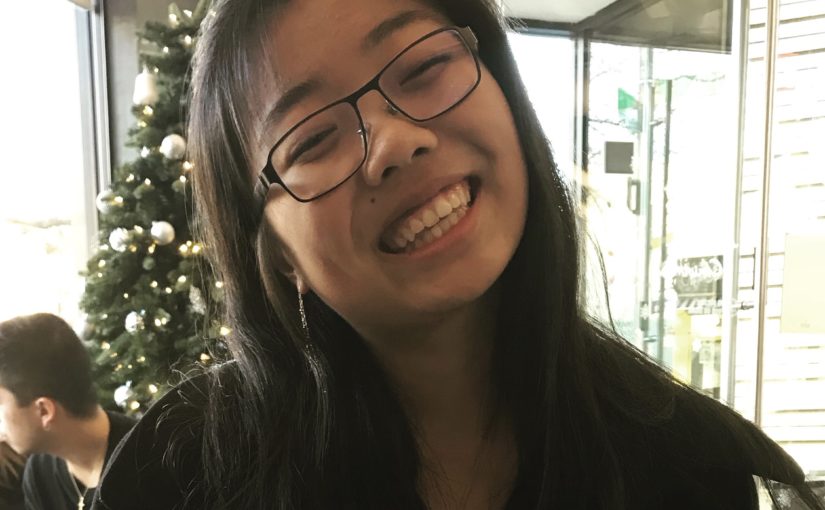
 Angela Li is a rising second year at the University of California, Los Angeles (UCLA), pursing a double major in Political Science and Asian American Studies. In the future, she hopes to explore the intersectionality of both her majors as a possible immigration lawyer. This summer she is interning at the USDA Animal Plant Health Inspection Service (APHIS).
Why did you decide to spend your summer with CAPAL?
As a Political Science and Asian American Studies double major, I’m always looking for opportunities that fall into the intersectionality of both my interests. CAPAL neatly ties together both my interests and gives me the opportunity to explore my Asian American identity with an amazing cohort of passionate individuals who share the similar identity.
Now in the internship, I feel an innate sense of pride and empowerment surrounded by so many AANHPIs discussing politics and working in the federal government. It seemed like a rarity in high school where I was one of only three Asian Americans who chose to take the AP U.S. Government elective and it continues to be a rarity in my Political Science classes where the majority of my professors and teaching assistants are white men. Even at the USDA-APHIS, I see a lack of AANHPIs staff members. And through CAPAL, I hope to hone in on the necessary skills needed to bring attention to and address issues affecting the AANHPI community, which don’t get much attention due to the lack of Asian American representation in politics.
I came into CAPAL thinking that I had only secured an internship in public service but I am receiving so much more. The WLPs have been great spaces to meet and hear from members of the extensive AANHPI network that CAPAL is invested in. My mentors have been such great resources to turn to for advice and for learning opportunities. The community action project has also given me the chance to directly bring attention to issues in the community.
What are some things that you did not expect coming into the internship?
On Sunday, June 17th, I left the dry heat of Los Angeles for the hotter temperatures of New York City and then traded that for a heatwave of humidity in Riverdale, Maryland. The daily thirty minute walk to the USDA Animal Plant Health Inspection Service (APHIS) on a route with almost no shade leads me to small cubicle on the third floor where I spend the rest of my nine-to-five day doing my assigned work and shivering in the cold, heavily air conditioned office. With all that being said, I wouldn’t necessarily trade the experience, except maybe for some windows and natural sunlight.
Coming into the internship, I did not expect the heat and the humidity but also, I did not expect the internship to test my own flexibility and adaptability. I went half way across the country to attend college but even that doesn’t compare to my situation right now: living alone in a tiny apartment in the suburbs. Within the span of two weeks, I’ve learned to prepare cost efficient meals, somewhat navigate the metro to and from DC, and make the best out of unfavorable situations. The last lesson is something that I have and will continue to utilize in my workspace. To make data entry more enjoyable, I started listening to podcasts on the side with my supervisor’s permission. After a week of little to no work, I’ve reached out to my supervisor suggesting research topics I could look into and I thank CAPAL for initiating these conversations through the Intern Goals worksheet. In the coming weeks, I hope to propose a series of intern workshops to my supervisor. The summer has just started and I look forward to see what other unexpectancies lies ahead.
 What are the projects that you’re working on this summer and how are they connected to your interests in public service?
With USDA-APHIS, I am currently researching their database of over eight hundred colleges nationwide to find student organizations working with or comprised of disabled students and/or veterans. This research will then be used to notify recruitment and outreach team members which clubs they should speak with to diversify the hiring pool. Additionally, I will be aggregating and consolidating existing demographics that USDA-APHIS has on their employee to see how recruitment can be improved upon.
For CAPAL, I am working with several other interns and Asian Americans Advancing Justice (AAJC) to explore the influence of technology in Asian American communities. With the world becoming ever so digital, it’s hard to notice members of the community who don’t have access to technology or have limited digital literacy. The model minority myth also has the false implication that all Asian Americans can afford to participate in this digital world. Our group will collect and share the stories of some individuals without technological access to give a more comprehensive understanding of the interactions or lack thereof that Asian Americans have with technology.
What is something that people usually don’t expect or know about you?
My friends diagnosed me as tone deaf after multiple failed karaoke sessions and five years in senior choir where I had to lip sync my parts as a soprano. I am also rhythmically challenged but still managed to play five years of violin.
What do you do in your free time?
When I’m not working or procrastinating on some kind of assignment, I’m usually eating, cooking or taking pictures of food. Outside of food related activities, I like going shopping with friends, exploring neighborhoods and kayaking or boating in New York City. I’ve been trying to read more outside of the course-related materials. Right now, I’m reading a poetry collection called Barbie Chang by Victoria Chang.
Meet all of our CAPAL Scholars & Interns here.
 Sharon Le is a rising third-year student at the University of Virginia, double majoring in Psychology and Spanish, on the Pre-Law track. Sharon served as the External Vice President for the Vietnamese Student Association (VSA@UVA) the past year, and is also involved in Phi Alpha Delta – the International Pre-Law Fraternity, and the Alcohol and Drug Abuse Prevention Team at the University. She was greatly exposed to the Asian Pacific American representation not only through her involvement with the Vietnamese community in Northern Virginia with VSA but also through her background – having grown up in Vietnam and moving to America in high school. Sharon hopes to promote Asian Pacific American leadership with her commitments and to give the community a bigger voice in the country.